
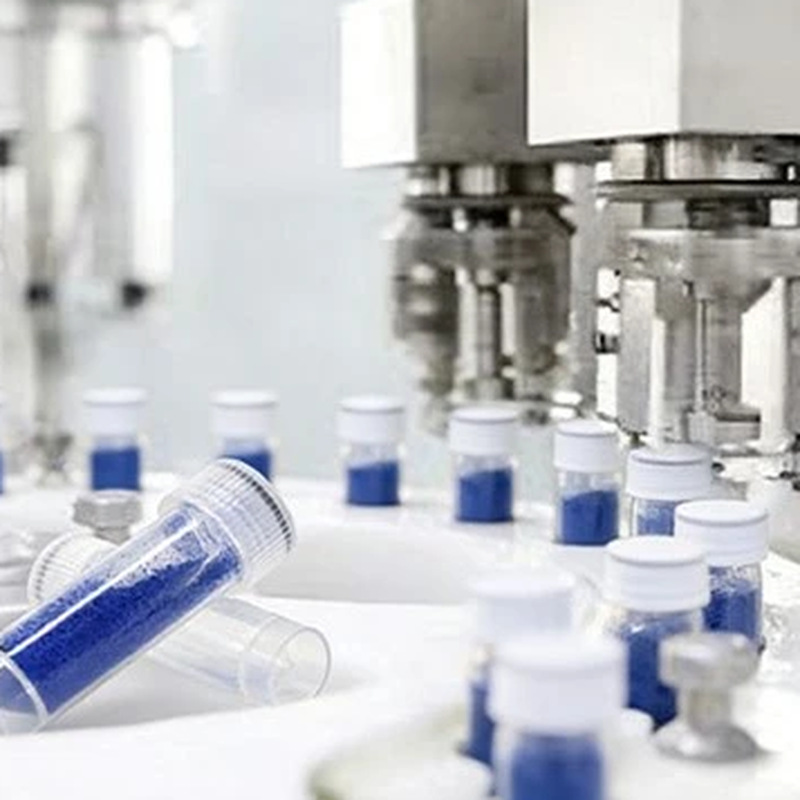
The two names are often used as if they were interchangeable. They are not. GHK is the free tripeptide glycine-histidine-lysine. GHK-Cu is that peptide complexed with a copper ion, which is why the powder is blue rather than white to off-white.
Three things that actually differ
They carry different registry numbers, so the CAS line is the fastest way to see which one a quotation describes. They have different molecular weights, which matters if your formulation calculates molar rather than mass inclusion. And they place different demands on a formula: a copper complex brings colour and copper ions into a system that may also contain chelators and a preservative.
What the blue colour does and does not prove
A blue cast is consistent with a copper complex, but colour intensity is not an assay. It says nothing about peptide identity, purity or copper stoichiometry. If your incoming-goods specification needs to distinguish the complex from the free peptide, ask for an identity result (for example LC-MS) and a copper content determination by an agreed method, and state both on the purchase specification.
Formulation questions worth settling at sample stage
For a transparent serum, check the chelator (EDTA and similar), the preservative system, the pH window and the packaging. A blue tint that is acceptable in an opaque airless bottle can be a rejection reason in clear glass. Confirm clarity and colour after freeze-thaw cycling and accelerated storage, not only on the day of manufacture.
Check the CAS line on any quotation before comparing prices. If you need both the free peptide and the copper complex quoted, ask for them as two separate line items with their own specifications and document lists.